





dadasd
06
2026.05
Single-Visit Dentistry: Is Your Clinic Ready for a Fully Digital Workflow?
Single-visit dentistry is a practical standard in modern restorative care. A connected digital workflow brings scanning, design, fabrication, and delivery into one chairside sequence, so selected restorations can be completed within a single appointment. The appeal is easy to see in daily practice: fewer return visits, tighter scheduling, and a treatment process that stays under the clinic’s control from start to finish.
Real efficiency comes from connection, not from adding isolated pieces of equipment. Scan quality shapes the design stage. Design quality shapes fabrication. Fabrication quality affects finishing, seating, and total chair time. Once those steps run as one continuous workflow, same-day treatment stops feeling exceptional and starts fitting naturally into routine restorative care.
What Defines Single-Visit Dentistry
Single-visit dentistry refers to a restorative approach in which a suitable case moves from digital impression to final delivery during one visit. In most practices, that includes single-unit crowns, inlays, onlays, veneers, and selected implant restorations that fit a chairside CAD/CAM workflow. Speed matters here, though speed alone does not define the model. Case suitability, margin clarity, occlusion, material choice, and production time all influence whether the appointment remains efficient.
A clinical model built around continuity
Continuity is what gives single-visit treatment its operational value. Unlike traditional restorative care, which often breaks cases into separate steps spread across multiple appointments, outside labs, and repeated communication loops, a digital workflow maintains a tighter chain where the team gathers data, examines the design, handles fabrication, and provides the restoration all within one unified process. This framework aids in making faster decisions and achieving neater execution, as fewer variables remain outside the practice.
Why clinics are moving toward same-day treatment
Patient expectations have changed, and clinic operations have changed with them. Fewer visits are easier for patients to accept and easier for practices to schedule. Production closer to the chair also gives the team more visibility over timing, fit, and delivery. That kind of control matters more than flashy technology claims. In a busy restorative setting, a workflow that stays predictable has direct value in output, staffing rhythm, and patient experience.
How the Workflow Moves from Scan to Delivery
A single-visit case follows a simple order: scan, design, mill, finish, and seat. Execution is where the difference shows. Weak data at the beginning slows everything that follows. Strong data shortens decisions and keeps fabrication moving. Good same-day workflows feel coordinated rather than rushed because every stage has been built around clinical pacing instead of technical novelty.
Digital scan acquisition
The opening stage has one job: capture accurate data quickly enough to keep the appointment moving. Margins need to read clearly. Occlusal information needs to be stable. Surface anatomy needs enough detail for clean design work. Digital capture strengthens the workflow here because the team can check the result immediately and correct problems before they spread downstream. A weak impression creates hesitation. A clean one gives the case momentum.
CAD design and restoration planning
Design is where digital information turns into a restoration that can actually be fabricated and seated. Contacts, contours, occlusion, anatomy, and material selection all need to work together before the file goes into production. Design discipline has a direct effect on milling time and adjustment time. When contours are overbuilt, contacts are heavy, or occlusion is poorly managed, chairside efficiency disappears fast. A well-structured design phase reduces that friction and keeps the treatment sequence compact.
Chairside milling and final delivery
Fabrication brings the workflow into real time. Milling speed matters, though speed without stability usually creates extra work at the end of the appointment. Tool management, cooling, machine rigidity, and material behavior all affect how cleanly the restoration comes out. Finishing and seating are easiest when earlier stages were handled well. By the time the case reaches delivery, the quality of the full digital workflow is already visible in fit, adjustment needs, and total time in the chair.
Why High-Accuracy Scanning Shapes Same-Day Results
High-accuracy scanning has an outsized effect on same-day treatment because every later decision depends on the first dataset. Margin clarity affects fit. Full-arch consistency affects occlusion. Data quality also influences how confidently the team moves into design without rescanning or second-guessing the case. Once the initial scan is off, the problem rarely stays contained. It travels into design, then into milling, then into seating.
Speed and detail in daily use
Daily chairside work needs capture speed and detail at the same time, which is why a scanner like M5 Pro fits naturally into this part of the workflow. Full-arch scanning in under one minute, 24 fps acquisition, a 0–20 mm depth of field, open output in STL, PLY, PTY, and OBJ, precision up to ≤6 μm, and accuracy up to ≤8 μm all support faster case entry without giving up detail. Motion sensing, one-button control, USB 3.0 connectivity, and six autoclavable tips also matter in repeated use, where handling comfort and quick turnover affect how smoothly the day runs.
Clinical value across the workflow
Stronger scan data reduces friction later in the appointment. Margins are easier to define. Contacts are easier to shape. The team spends less time correcting the foundation of the case and more time moving it forward. Better capture quality also improves digital flexibility because open-file output keeps the design and fabrication stages from feeling boxed into a narrow system. For single-visit care, that kind of reliability is not a nice extra. It is what keeps the workflow moving without constant interruption.
How Chairside Milling Supports Crowns and Inlays
Chairside milling is what turns a digital plan into a same-day restoration. Once the design is approved, the practice needs a production stage that fits inside a live appointment instead of pushing the case back into a delayed timeline. Crowns and inlays are the clearest examples because they appear often in daily restorative work and place immediate pressure on turnaround time. Bring fabrication in-house, and the schedule tightens. Push fabrication outward, and control over the appointment weakens almost immediately.
Wet milling advantages in same-day restorative care
Wet milling suits many chairside indications because cooling and machining stability support restorative production under real clinical time limits. A machine such as BSM-520W works well in that role with a 5-axis wet milling configuration, solid gantry structure, high-strength cast-iron core components, thermal symmetry design, a 16-tool magazine, automatic water cooling, a 2500 W spindle, and spindle speeds up to 60,000 RPM. More important than the hardware list are the case times: about 20 minutes for a full-contour posterior crown, around 15 minutes for a coping, about 40 minutes for a three-unit full-contour crown bridge, and roughly 30 minutes for a customized abutment. Numbers like those make chairside production believable inside a same-day schedule.
Greater production control inside the practice
In-house milling changes the logic of the appointment. Preparation, design, fabrication, finishing, and seating stay connected rather than scattered across separate timelines. Scheduling gets easier because the team controls more of the case directly. Communication also gets simpler because fewer steps depend on outside coordination. A tighter production loop usually leads to a tighter patient experience, especially in common crown and inlay cases where treatment speed is part of the value.
When Dry Milling or Wet Milling Makes More Sense
Different materials place different demands on fabrication. Some restorations fit dry processing neatly. Others need wet processing because cooling conditions affect surface quality, tool wear, and production stability. Practices with a broader restorative mix usually benefit from keeping both options available. A narrow production setup may feel efficient on paper and become restrictive once real case variety starts showing up.
Flexible chairside production across materials
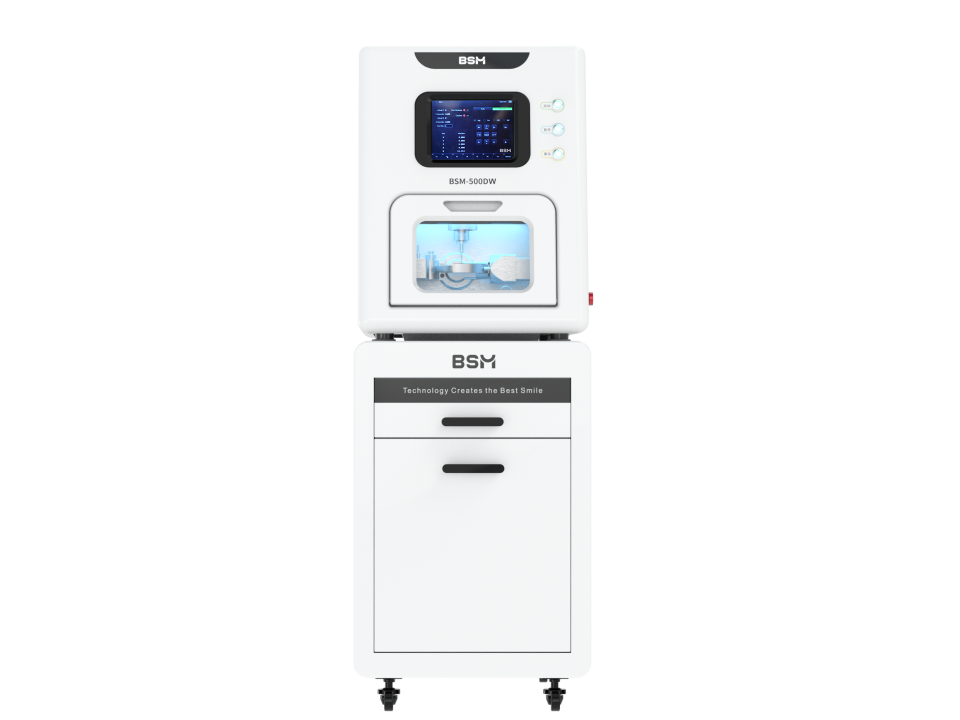
A dual-mode system addresses that problem directly. 500DW supports both dry and wet milling in a chairside setting and switches modes in about 30 minutes, which gives the team more room to work across zirconia, glass ceramics, titanium, and other materials. Disc capacity also improves with a one-third holder that raises zirconia disc utilization by more than 20 percent. Ninety-degree vertical milling supports more natural anatomy and customized titanium abutments, while an 800 W German spindle running up to 80,000 RPM and a 13-bur automatic changer with smart monitoring broaden the unit’s production range. Break-point resume, power-failure protection, status alerts, remote control, and integrated cleaning support add practical value because daily workflow depends on uptime as much as raw specification.
A broader treatment range for the clinic
Production flexibility influences clinical range and commercial logic at the same time. More materials processed in-house means fewer cases pushed out for avoidable reasons. Better utilization follows because equipment is handling a wider mix of restorative work instead of sitting idle outside a narrow indication band. A digital workflow built around that kind of range is easier to scale and easier to integrate into routine scheduling.
Case Selection and ROI Considerations
Case selection decides whether same-day dentistry feels efficient or forced. Posterior single-unit crowns, inlays, onlays, and comparable restorations usually fit best because margin control is clearer, occlusion is more manageable, and fabrication stays realistic within one visit. Poor case selection tends to erase the advantages of digital speed. Strong case selection preserves them and makes the workflow repeatable across daily practice.
Conclusion
Return builds through several operational gains working together: shorter treatment cycles, steadier scheduling, stronger chair utilization, more production handled in-house, and a patient experience that feels efficient without feeling rushed. Practices usually get the best result when scanning, design, and milling have been chosen as part of one connected workflow rather than pieced together as isolated purchases. That system view is where Besmile fits most naturally.